
Sunday Art Dialogue: Architectonic Art
Updated: May 27
May 17th 2026
Hello again. This is the second Sunday Art Dialogue, which is a new weekly post in which I share thoughts, reflections and ideas across a wide range of art topics.
Each week I hope to open up conversation, inviting you to engage, respond and share your own perspectives. Art is always richer in dialogue, and I would love you to be a part of it.
Today I would like to briefly discuss the word architectonic... used frequently to describe artworks.
In visual art, architectonic describes the way an artwork is structured, organized, and built as a coherent whole. The term comes from architecture, so it emphasizes the "construction" of the composition rather than just its subject matter.
An architectonic artwork often feels:
* Carefully ordered
* Structurally balanced
* Solid or monumental
* Unified by underlying geometry or compositional logic
Artists, critics, and art historians use the word to talk about how forms relate to each other spatially and rhythmically. The core idea is...
An architectonic composition is one where the arrangement of shapes, lines, masses, and spaces feels intentionally constructed — almost like a building. For example in modern art the term is used for abstract or modern works where the composition feels engineered or constructed such as in Piet Mondrian's grid paintings or Paul Cezanne's structured landscapes
where his work balances painterly brushwork with an architectonic composition, meaning the surface handling is expressive, but the overall structure in tightly organised.
For discussion I have featured here four works by my gallery artists which I feel exemplify the meaning of architectonic.
Susanna Lisle (painting)
2. Richard Crooks (collage)
3. Lynn Baxter (painting + collage) a
4. Julia Atkinson (Screenprint).
What are you opinions...how does this relate to your works or others you have seen and how do you respond to these.
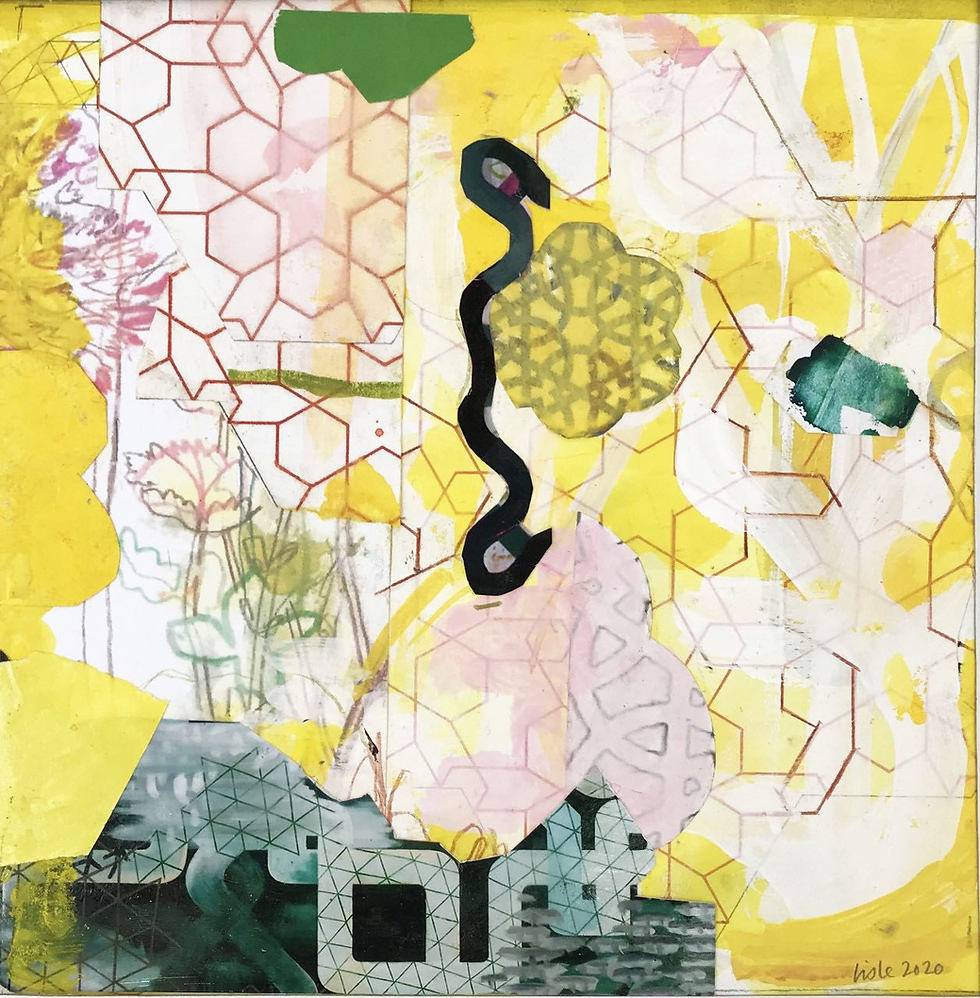
Susanna Lisle
Tracery & Tendril Gouache & collage.
20 x 20 cm

Richard Crooks Gold, silver and a little bronze
Analogue mixed media collage, pencil, biro, gouache, acrylic.
53 x 43 cm

Lynn Baxter
Archipelago Acrylic on board
46 x 57 cm

Julia Atkinson Interchange Series 23 Version Orange
Screenprint 70 x 50cm
Following on from my Sunday Art Dialogue post today, this amazing thought has always made me think how intriguing Mondrian's ideas about artists, other than his own circle, were and I though this might be of interest.
It was reportedly Piet Mondrian who strongly encouraged Peggy Guggenheim to pay attention to Jackson Pollock.
The often-repeated story is that Mondrian saw Pollock's work in the early 1940s and told Guggenheim something to the effect that Pollock was "the most exciting painter" he had seen in America. That endorsement helped convince her to exhibit and support him at her gallery, Art of This Century, where she gave Pollock his first solo show in 1943 and became one of his maior patrons.
Here is a photo of Mondrian's studio where he structured his life as well as his paintings. How extraordinary it was that he could recognise the talent of the Action Painter Jackson Pollock and recommend him to one of the greatest art collectors of the time!
Credits: L'atelier parisien de Mondrian reconstitué dans sa maison natale à Amersfoort


Comments